Pawn Shop Simulator Games: Why the Genre Hooks You
Updated July 7, 2026 · by Oguz Yildiz
A pawn shop simulator puts you behind the counter: strangers bring you items, you judge what they are really worth, you haggle, and you live with the outcome. The genre took off because that loop — appraise, negotiate, resell — is one of the purest risk-reward cycles in games. Here is what makes a good pawn shop game, and how Lux Broker moves the formula upmarket into watches, diamonds, and police raids.
Why the pawn shop loop hooks people
Every customer is a self-contained gamble. The item might be a bargain or a fake; the seller might be desperate or shrewd; your offer might close the deal or blow it. Unlike slot-machine mechanics, the odds respond to skill — you get better at reading items and people, and the game rewards it immediately in profit. That “I knew it was fake” moment is the genre’s core dopamine, the same pull that made TV pawn shows compulsive viewing.
What separates good pawn shop games from clickers
- Real appraisal mechanics. If every item’s value is printed on it, there is no game. You want inspection tools, reference prices with uncertainty, and genuine fakes.
- Negotiation with personality. Counter-offers should meet resistance that differs by customer — not a fixed discount slider.
- Consequences that persist. Bad deals should cost something beyond one transaction: reputation, heat, opportunity.
- Progression that changes the game. Better stock and richer clients, not just bigger numbers.
How Lux Broker plays the genre
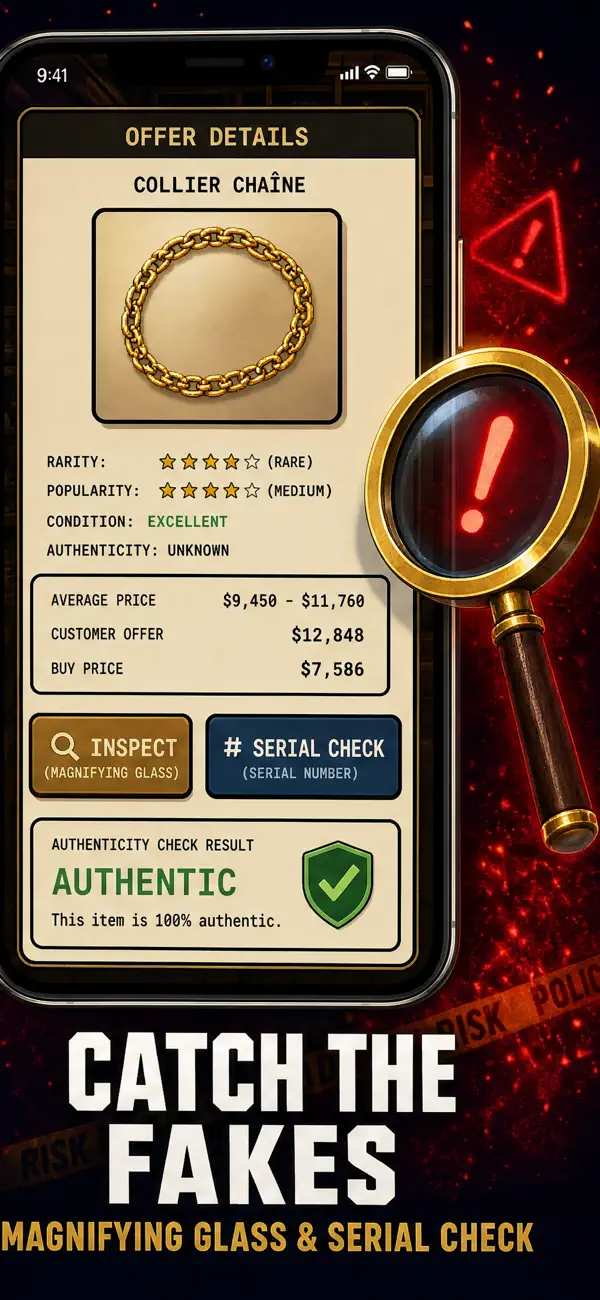
- Luxury inventory, real stakes. 30+ items — chronograph watches, diamonds, handbags, paintings — each with a market range you learn rather than read.
- Fake detection as a skill tree. Loupe the details, check serial numbers, and level your expertise from Novice to Master; sloppy authentication sells fakes and burns reputation.
- 19 customer types to read. Distressed sellers fold fast, collectors know the market, status buyers overpay but bring risk — the negotiation system is the heart of every deal.
- Risk, raids, and the three-tier climb. Shady profit fills a risk meter that eventually knocks on the door in uniform: bribe, surrender, or resist. Survive and climb from trinket stall to luxury house.
Getting good: three opening-hours tips
- Buy the seller, not the item. A distressed seller’s asking price has more room in it than the item’s condition suggests.
- Authenticate everything above your comfort line. The check costs seconds; a sold fake costs reputation you rebuild for days.
- Bank reputation early. Clean deals in Tier 1 buy you slack for the aggressive plays Tier 3 rewards.
Related questions
Is Lux Broker like Dealer’s Life?
Same genre family — walk-in customers, appraisal, haggling — with a sharper focus on luxury goods, counterfeit detection, and the risk/raid layer. If the pawn loop is what you enjoy, this is that loop with higher stakes per deal.
Is it free?
It is $0.99, pay-once — which buys the absence of everything that plagues free sim games: no ads, no energy timers, no pay-to-win.
Do pawn shop games need internet?
The good ones are single-player and session-friendly — Lux Broker deals take about a minute each, which is exactly the queue-at-the-coffee-shop format.