Negotiation Games: Where Haggling Is the Whole Game
Updated July 7, 2026 · by Oguz Yildiz
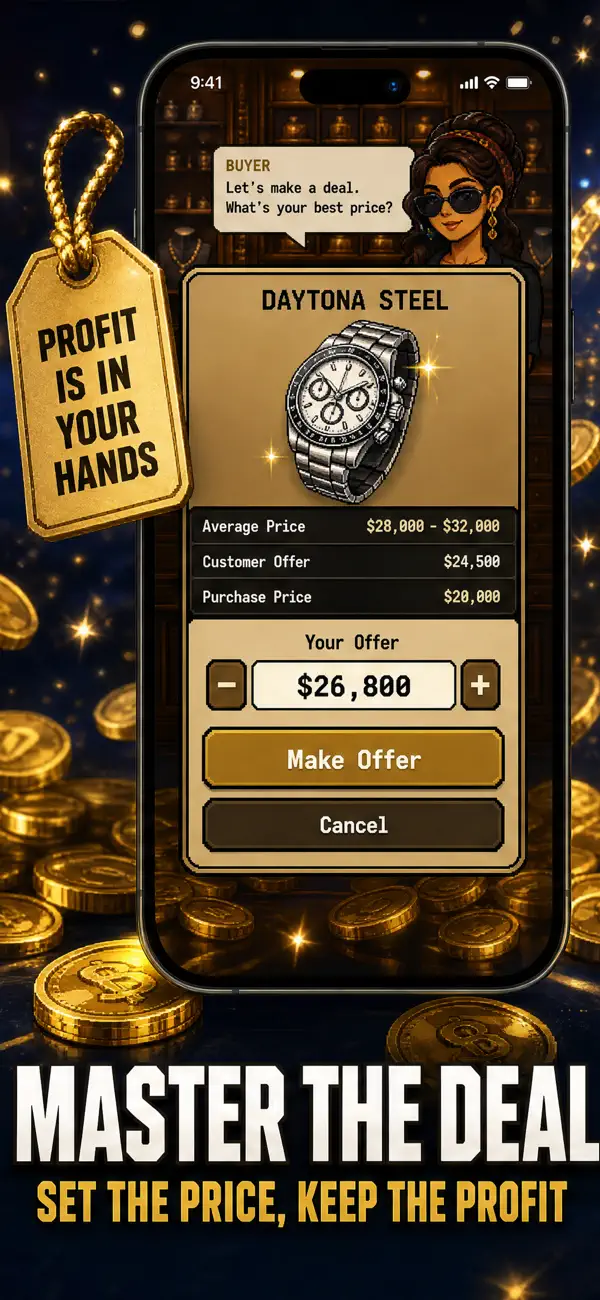
A negotiation game makes the haggle itself the gameplay: reading the other side, probing their limit, and closing at the best number they will still accept. It is a rare genre — most games treat trading as a menu, not a conversation — and when it is done well, every deal feels like a small boss fight. Here is what makes negotiation mechanics work, and how Lux Broker builds an entire game on them.
What makes negotiation fun in a game
Real negotiation is information warfare: each side knows something the other doesn’t. A good negotiation game recreates that with hidden reservation prices — the number beyond which the other side walks — and observable behavior that leaks hints about it. Your skill is inference: opening offers, hesitations, and counter-speed all telegraph how much room remains. Games that skip the hidden information (fixed prices, visible sliders) aren’t negotiations; they’re checkout screens.
The mechanics checklist
- Hidden breaking points that differ per opponent — otherwise one strategy solves everything.
- Behavioral tells. Reaction to your counter should carry information worth reading.
- Walk-away risk. Pushing too hard must be able to kill the deal, or “always lowball” dominates.
- Stakes beyond the deal. The outcome should feed a larger economy — reputation, inventory, progression — so a won negotiation compounds.
How Lux Broker turns haggling into the whole game
- 19 opponents, 19 styles. Distressed sellers accept fast, low offers; collectors know the market and punish insults; status buyers pay premiums but carry risk; suspicious types bring fakes. Learning who folds and who walks IS the skill curve.
- Both sides of the counter. You negotiate buying (their item, your lowball) and selling (your item, their lowball) — the same reads, inverted.
- Value uncertainty raises the stakes. The market range is a band, not a number, and authenticity is on you — a brilliant negotiation on a fake is still a loss. (The appraisal half of the game is covered in the pawn shop simulator guide.)
- Deals feed the empire. Profit climbs your tier, reputation shapes who visits, and greedy shortcuts fill the risk meter that ends in a police raid decision.
Haggling tactics that actually work in-game
- Anchor first when you can. An aggressive-but- sane opening shifts the whole negotiation toward your number.
- Move in shrinking steps. Big concession, then smaller, then tiny — it signals you are near your limit even when you are not.
- Let the customer type pick the tactic. Patience beats distressed sellers; fairness closes collectors; firmness milks status buyers.
- Know your own walk-away. The market band gives you one every deal — respect it and the profit takes care of itself.
Related questions
Do negotiation games teach real haggling?
The instincts transfer surprisingly well: anchoring, concession pacing, and reading urgency are the same muscles used at flea markets and car lots. A game is a consequence-free gym for them.
What’s the best negotiation game on iPhone?
Look for hidden limits, distinct opponent personalities, and economy stakes — the checklist above. Lux Broker was built to score on all three, at $0.99 with no ads breaking the tension mid-deal.
Is negotiation better than combat as a core mechanic?
It is combat — with words and numbers instead of hit points. The appeal is identical: pressure, reads, and the clean thrill of a perfectly executed close.